Saturday, 10 October, 2026

The Democratic Republic of the Congo (DRC) is one of Africa’s largest and most resource-rich nations, yet its energy sector remains severely underdeveloped. Electricity access is among the lowest in the world at approximately 19–20%, with stark disparities between major cities and rural communities. The national power system is characterised by limited generation capacity, outdated transmission infrastructure, and widespread dependence on biomass for cooking and heating, which accounts for more than 90% of household energy use.
Despite these constraints, the DRC is endowed with extraordinary renewable energy potential, including some of the world’s most significant hydropower resources. The Congo River basin contains massive untapped opportunities for electricity generation, but existing hydropower complexes—such as Inga I and Inga II—operate well below their design capacity due to aging infrastructure and insufficient maintenance. Industrial energy demand is driven heavily by the country’s extensive mining sector, particularly cobalt, copper, and other critical minerals, yet supply shortages remain a key barrier to value-addition and industrial growth.
With rising global interest in clean energy, electrification, and critical minerals for the energy transition, the DRC occupies a strategically important position. Its combination of abundant renewable potential, industrial demand, and resource wealth create strong long-term foundations for green energy growth and potential green hydrogen production.
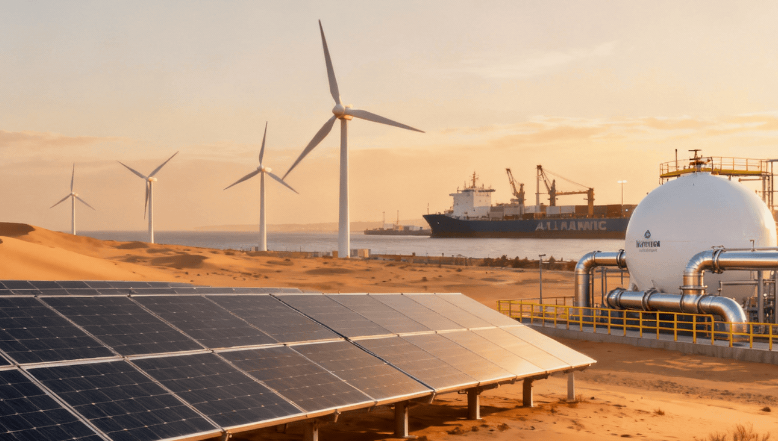
DRC currently has no operational hydrogen facilities, no hydrogen pilot projects, and no dedicated hydrogen strategy.
DRC has no hydrogen-specific policies, no regulatory standards, and no safety frameworks covering hydrogen, ammonia, or synthetic fuels.
DRC has no hydrogen-specific policies, no regulatory standards, and no safety frameworks covering hydrogen, ammonia, or synthetic fuels.
The DRC has more than 100 GW of technically viable hydropower potential—almost half of Africa’s total. The Grand Inga site alone could generate more than 40 GW, making it uniquely suited for large-scale, low-cost green hydrogen production if developed sustainably.
In addition to hydropower, the DRC experiences strong solar irradiance across much of its territory, especially in southern provinces such as Haut-Katanga and Lualaba, where mining activity is intensive. Solar irradiation ranging from 4.5 to 5.5 kWh/m²/day offers compelling opportunities for utility-scale solar development, hybrid microgrids for mining, and potential solar-to-hydrogen pilot projects. Despite this, solar deployment has remained limited due to high capital costs, insufficient grid infrastructure, and logistical constraints.
The country’s vast agricultural base and forest cover provide substantial biomass and biogas potential. Agricultural residues, forestry by-products, and organic waste could feed industrial biomass gasification or community biogas plants, supporting decentralised renewable energy and offering potential hybridisation with hydrogen for firming power.
DRC’s location along the western branch of the East African Rift System also offers promising, though underexplored, geothermal potential, particularly around the Virunga volcanic region. Geothermal, if developed, could provide climate-resilient baseload power suitable for continuous electrolyser operation.
Wind potential in the DRC is modest overall, but certain elevated regions could support small- to medium-scale installations for rural mini-grids or hybrid systems.
Overall, the DRC’s renewable potential—especially hydropower and solar—gives it a unique long-term advantage for large-scale, low-cost green hydrogen production. However, realising this opportunity will require major investments in infrastructure, improved governance, stable regulatory frameworks, and strong public–private partnerships.
The DRC currently has no manufacturing base for electrolyser systems, hydrogen compression or storage, fuel cells, or synthetic fuel technologies.
DRC does not currently have any announced hydrogen projects, hydrogen feasibility studies, or pilot electrolysis installations.
References:
Africa Energy Portal (2024).
Democratic Republic of the Congo – Country Energy Profile: Access rates, generation mix, hydropower statistics.
https://africa-energy-portal.org/country/democratic-republic-congo
World Bank (2024).
DRC Energy Sector Overview: Electrification, hydropower rehabilitation, Inga project status.
https://www.worldbank.org/en/country/drc
UNFCCC – DRC Updated Nationally Determined Contribution (NDC) (2021).
Energy transition commitments, renewable energy strategy, emissions reduction goals.
https://unfccc.int
Ministry of Hydraulic Resources & Electricity (DRC) – Sector Reform Law (2014).
Electricity market liberalisation, IPP frameworks, PPP concessions.
Société Nationale d’Électricité (SNEL) – Annual Performance Reports (2023–2024).
Operational status of Inga I & Inga II, generation performance, capacity use.
https://snel.cd
African Development Bank (AfDB) (2023).
Inga Rehabilitation & Transmission Expansion Projects – Technical & financial documentation.
https://www.afdb.org
Grand Inga Development Framework & Feasibility Studies (World Bank, AfDB, EU).
Hydropower potential estimates (40+ GW), regional export concepts.
International Renewable Energy Agency (IRENA) (2024).
Renewable Energy Statistics – DRC solar irradiance (4.5–5.5 kWh/m²/day), biomass, and geothermal assessments.
https://www.irena.org
United Nations Industrial Development Organization (UNIDO) – Small Hydropower Atlas (DRC Chapter).
Hydropower potential mapping across Congo River, tributaries, and regional clusters.
U.S. Geological Survey (USGS) – Critical Minerals Summary for DRC (2023).
Cobalt, copper, lithium mining demand and energy consumption trends.
https://www.usgs.gov
Mining Code of the DRC (Revised 2018).
Sustainability, investment conditions, and industrial energy-use regulations.
International Energy Agency (IEA) Africa Energy Outlook (2022/2023 editions).
Regional hydropower potential; green hydrogen cost-reduction pathways.
https://www.iea.org
East African Rift Geothermal Development Reports (2020–2024).
Geothermal prospects in eastern DRC (Virunga region).
Congo Solar IPP Feasibility Studies (Various Developers, 2022–2024).
Emerging solar development zones in Kolwezi, Lubumbashi, and Kasumbalesa.
Off-Grid Energy Market Assessment – DRC (GOGLA, 2023).
Mini-grid expansion programmes and decentralised solar uptake.
https://www.gogla.org