Tuesday, 27 October, 2026


Kiribati is a low-lying Pacific Small Island Developing State (SIDS) made up of 33 atolls and reef islands scattered over a vast ocean area but with very limited land, resources, and population. Its energy system is small, highly fragmented and almost entirely dependent on imported diesel fuel for power generation. South Tarawa, the main urban centre, is served by a centralised diesel grid managed by the Public Utilities Board, while outer islands rely on a mixture of diesel mini-grids, solar home systems and small community systems. Electricity demand is modest in absolute terms (a few megawatts of peak load), but the cost of supplying that demand is extremely high because of fuel import dependence, logistical constraints, and the need to ship diesel across long maritime distances.
To address this, Kiribati has adopted an Integrated Energy Roadmap 2017–2025 and a Scaling Up Renewable Energy Program (SREP) Investment Plan, both of which prioritise improved energy security, reduced fossil fuel dependence and increased access through renewables, especially solar PV with battery storage. The country’s updated NDC and NDC Implementation Roadmap reinforce these goals by committing to significant emissions reductions relative to business-as-usual scenarios, principally by replacing diesel generation with grid-connected solar.
Kiribati is actively exploring green hydrogen as part of its strategy to reduce fossil fuel dependence and boost energy independence, with feasibility studies showing promise for hybrid microgrids using solar power for electrolysis to produce hydrogen for energy storage and potentially transport, even though initial costs are higher than batteries, offering a cleaner disposal solution. The government's Energy Roadmap targets significant renewable energy integration, and research indicates green hydrogen could become viable as production costs decrease, supporting a shift from diesel generators in South Tarawa.
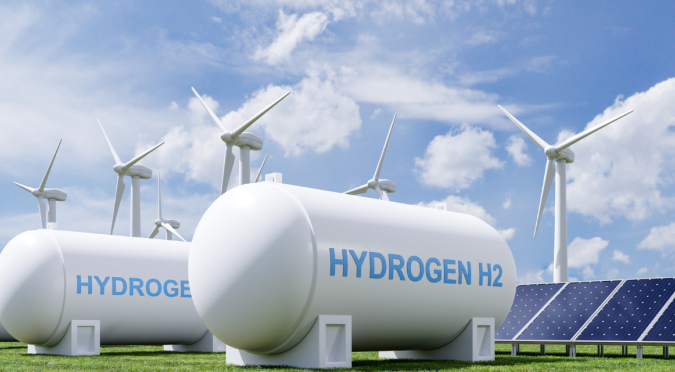
Kiribati currently has no hydrogen production, infrastructure, or end-use applications, and hydrogen is not part of its immediate energy strategy.
There is no hydrogen-specific policy in Kiribati. However, Kiribati has a clear high-level policy direction for its energy transition that indirectly shapes any future hydrogen conversation. The Nationally Determined Contribution (NDC) and NDC Implementation Roadmap commit the country to replacing a substantial portion of diesel-based electricity generation with large grid-connected solar PV and associated storage, contingent on international finance and support. The Integrated Energy Roadmap (KIER) emphasises energy security, affordability and sustainability, focusing on solar PV, energy efficiency and system strengthening, while the SREP Investment Plan outlines a phased programme for scaling up solar and storage on South Tarawa and Kiritimati.
There is no hydrogen-specific regulation in Kiribati.
Kiribati's 2025 energy profile is defined by its ambitious Kiribati Integrated Energy Roadmap (KIER), aiming to drastically cut imported fossil fuels through solar power and energy efficiency, targeting significant reductions (45-100%) in South Tarawa, Kiritimati, and outer islands by 2025, focusing on solar PV, wind, desalination, and improved grid systems to boost energy security, affordability, and climate resilience for its vulnerable island nation.
Kiribati’s renewable energy potential is dominated by solar PV. The atolls lie near the equator and benefit from strong, relatively stable solar irradiance year-round, comparable to other equatorial Pacific islands and well suited to both rooftop and ground-mounted PV.
Wind resource assessments have been carried out on Kiritimati Island and Tarawa, with some indications of viable wind speeds in specific locations, but no wind farms have yet been developed, and solar remains the preferred technology because of its maturity, modularity and simpler integration. According to IRENA’s latest statistical profile, Kiribati’s installed renewable capacity is almost entirely solar; in recent years, renewable electricity has grown significantly from a very low base, and solar accounted for around 15 percent of electricity or primary energy use in 2020, with further increases expected as ongoing projects are commissioned.
The government, with support from ADB, the World Bank, the Green Climate Fund and other partners, is implementing the South Tarawa Renewable Energy Project (STREP) and subsequent phases, which will deliver several megawatts of grid-connected solar PV and battery storage to displace diesel generation on the main grid. Additional investments envisaged under Phase II of the SREP Plan include further solar and storage for South Tarawa and Kiritimati, with an explicit objective of meeting Kiribati’s KIER and NDC targets by 2025.
Kiribati does not possess any industrial base suitable for hydrogen technology manufacturing or assembly.
There are no hydrogen projects in Kiribati at present.
References:
Asian Development Bank (ADB). South Tarawa Renewable Energy Project (STREP) – Grid-connected solar PV and battery storage investment documentation.
Government of Kiribati. NDC Implementation Roadmap & Updated Nationally Determined Contribution (NDC) – Renewable energy and diesel displacement commitments.
SPC (Pacific Community) / Government of Kiribati. Kiribati Integrated Energy Roadmap (KIER) 2017–2025 – Final Report .
Government of Kiribati & SREP. Scaling Up Renewable Energy Program (SREP) Investment Plan – Kiribati – Phase I & II solar + storage roadmap.
IRENA (2024). Kiribati Country Energy Statistics – Solar Capacity, Renewable Energy Share .
World Bank / UNFCCC. Kiribati NDC Update – National Energy Mix & Diesel Dependence .
Pacific Regional Data Repository (PRDR) / SPC. Wind & Renewable Resource Assessments for Kiribati – Kiritimati & Tarawa wind trials.
ADB / Government of Kiribati. South Tarawa Grid Stabilisation & Solar PV Integration Works (STREP Phase II).
SREP / SPC. Outer Islands Solar & Hybrid Mini-Grid Feasibility Studies .
Pacific Hydrogen Economy Study (SPC, 2023). Modelling future hydrogen scenarios for Pacific SIDS – demand-side roles for microstates .
Kiribati Energy Ministry / UNDP. National Energy Policy – Renewable Energy Targets & Technology Priorities .
NDC Registry – Kiribati. Transport & Electricity Sector Emission Reduction Measures .
Kiribati Public Utilities Board (PUB). Renewable Energy & Grid Operation Data – Tarawa Electricity System .
PRDR / SPC. Solar Resource Assessment – Kiribati (irradiance maps & feasibility notes).